

No one decides to change their accounting setup because things are going smoothly.
That decision usually comes after a stretch of small frustrations that never felt urgent enough to escalate, yet never fully went away.
Reports are being delivered, but they lead to follow-up questions. Closures are completed, but they feel rushed every single time. Board conversations take longer than expected because the numbers require explanation, and then further clarification.
Nothing appears to be broken on the surface. However, nothing feels fully reliable either.
At some point, leadership recognizes that something needs to change.
This is where the real risk begins.
While the system is being reconsidered, the business itself does not slow down to accommodate that change. Rents continue to be collected. Vendors still expect to be paid on time. Projects move forward with financial implications attached to them. Board expectations do not decrease during this period. In many cases, they increase.
A transition does not happen in isolation. It happens in the middle of ongoing operations that cannot afford disruption.
The Part Where Most Transitions Get Wrong
Accounting transitions are often treated as technical projects.
In reality, they are operational challenges.
It is true that data needs to be migrated, systems need to be configured, and reports need to be rebuilt. However, those are not the areas where transitions typically fail.

The real breakdown occurs when day-to-day operations begin to feel the impact.
When a report is delayed, even slightly, a maintenance decision may be postponed. When numbers do not fully align, someone hesitates before approving an expense. When a vendor’s payment is delayed, it leads to difficult conversations that could have been avoided.
Each of these issues may seem manageable in isolation.
However, when they begin to occur together, the way the team operates starts to change.
The environment becomes more cautious, more reactive, and less confident.
That shift carries a real cost, and it tends to happen quickly.
The Reality of Split Systems and Its Impact
There is a phase in every transition that is rarely planned for in detail, yet almost always occurs.
This is the period of overlap between systems.
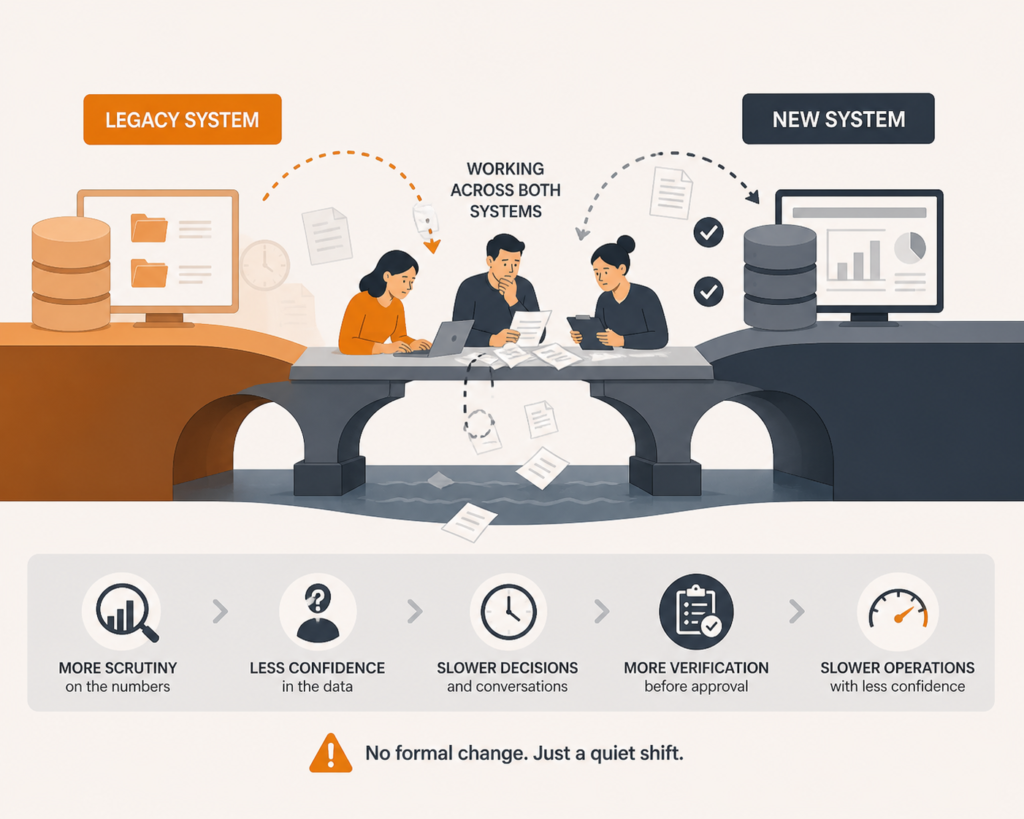
The legacy system continues to hold historical data, while the new system begins to process current activity. As a result, the team is required to work across both environments at the same time.
They are closing current periods while attempting to reconstruct past records. They are validating numbers that would not normally require this level of scrutiny. They are reviewing work that has already been completed once before.
From an external perspective, the work continues to be done.
Internally, it requires significantly more effort.
Over time, a subtle but important shift begins to take place.
The team stops trusting the numbers instinctively. This does not necessarily mean the numbers are incorrect, but there is enough uncertainty to create hesitation.
As a result, decisions take longer. Conversations become more cautious. Approvals require additional verification.
No formal change is announced, yet the entire operation begins to move more slowly and with less confidence.
How We Approach Transitions Differently
At Reliabledger, we do not begin with the system.
We begin with understanding how the business actually operates.
Every real estate portfolio has its own rhythm. Some teams manage high transaction volumes. Others handle multiple properties with varying reporting expectations.
In many cases, teams are already operating under pressure before a transition begins.
If these realities are not considered, even a well-designed system can create friction.
Before initiating any changes, we will map the current operation in detail. We identify where pressure tends to build, where delays typically occur, and which financial outputs are critical for decision-making.
The purpose of this step is not to immediately introduce change. Infact, it is to ensure that the existing operation remains stable while the transition is being prepared.
Separating Live Operations from Historical Cleanup
A common source of strain during transitions is the attempt to manage ongoing operations while also correcting historical data within the same workflow.
Although this approach may appear efficient, it often leads to conflicting priorities.
Historical cleanup requires time, careful review, and attention to detail.
Live operations require consistency, speed, and responsiveness.

When both are handled together, the team is forced to divide its focus.
This often results in delays, increased error risk, and additional stress.
Our approach is to separate these streams.
Ongoing financial activity continues with structure and clarity, ensuring that day-to-day operations remain stable. At the same time, historical data is reviewed and corrected in parallel, without placing additional pressure on the operational team.
The Importance of the Validation Phase
The most critical stage of a transition is neither the initial setup nor the final implementation.
It is the period between when both systems are operating simultaneously.

This phase is often shortened due to time pressure or a desire to complete the transition quickly. However, doing so increases the likelihood of issues appearing after the transition has been finalized.
During this phase, we conduct structured validation.
Outputs from the new system are consistently compared with those from the legacy system.
Any discrepancies are examined carefully and resolved with clarity.
This process ensures that the new system is not only technically accurate but also aligned with the operational realities of the business.
It also allows the team to become familiar with the system in a practical, hands-on way.
By the time the transition is complete, the system is no longer unfamiliar. It has already been tested, understood, and validated.
What a Well-Executed Transition Looks Like
A well-managed transition does not feel disruptive.
There is no sudden shift or moment of uncertainty.
Instead, improvements become noticeable over time.
Financial reports become clearer and easier to interpret.
Decisions are made with greater confidence and less delay.
Communication across teams becomes more direct, as the numbers no longer require repeated explanation.
Most importantly, the team regains confidence in financial data.
Once that confidence is restored, the overall pace and quality of decision-making improve.
What This Ultimately Comes Down To
A successful transition is not defined by speed.
It is defined by stability.

If the business experiences hesitation, disruption, or reduced confidence during the transition, the process has not been managed effectively.
The objective is not simply to implement a better system.
The objective is to reach that outcome while maintaining the continuity and reliability of the operation.
Key Takeaways
Transitions should be approached as operational challenges, not just technical projects, because the primary risk lies in disrupting ongoing business activity.
Managing historical cleanup and live operations together often creates unnecessary pressure. Separating these streams allows each to be handled more effectively.
The overlap between systems is the most critical phase of the transition and should be treated as a structured validation period.
Confidence in financial data is built through consistent validation and alignment with real-world operations, not just through data migration.
A successful transition is one that allows the business to continue operating smoothly while improvements are being implemented.
0 Comments